Saturday, March 21, 2015

Making Chicken More Interesting

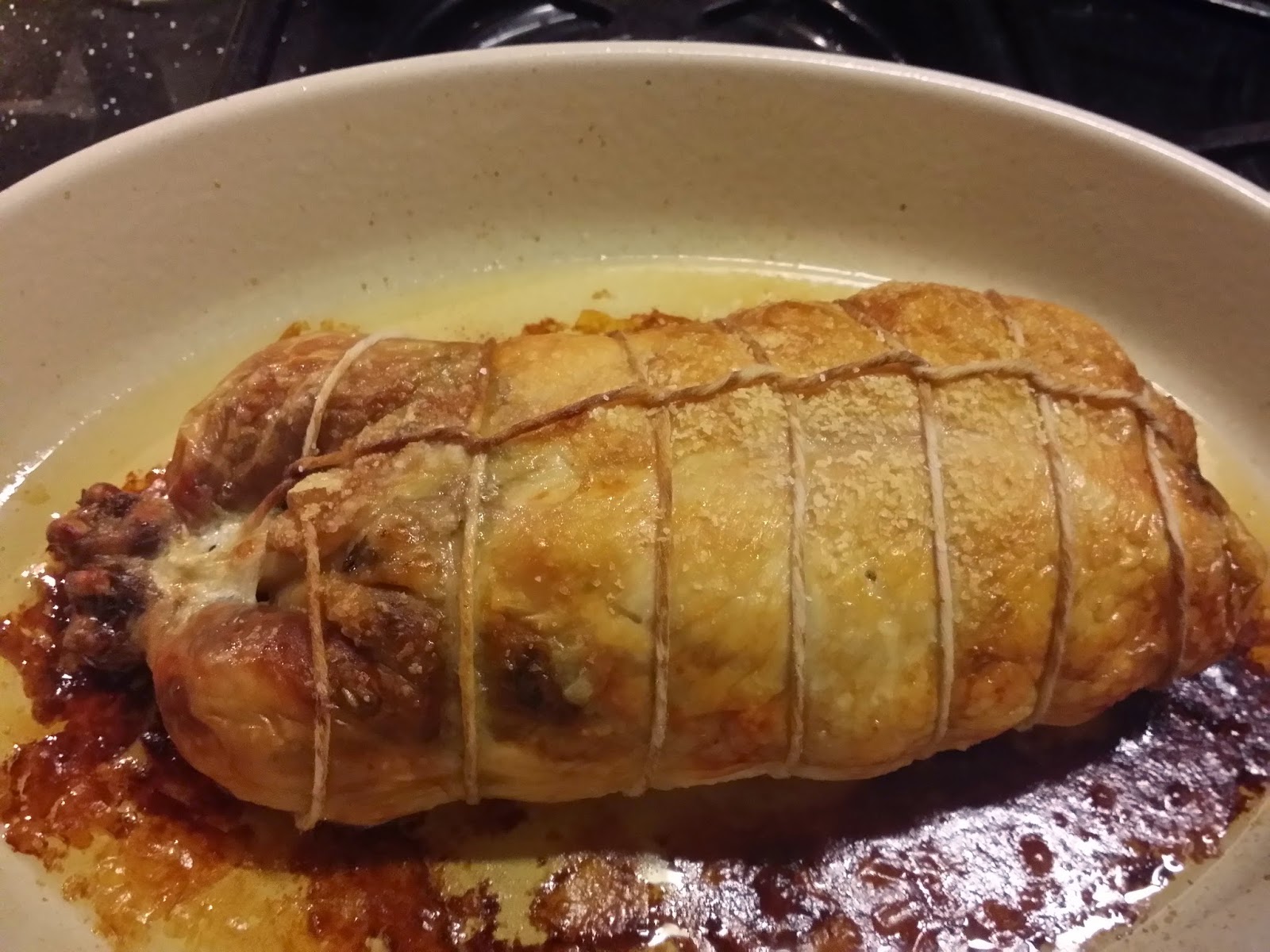
Chicken Ballotine.  Photo by Rob Robitaille
I love chicken, but let's face it, chicken can be very boring.  My wife has a peculiar digestive system where she finds that she can no loner tolerate mammal meat. So, that just makes my life as the cook a bit more difficult as it cuts out many delicious options.  So, instead of viewing it as a problem, I am choosing to view it as a challenge.  After all, the French love their chicken.  So much so, that they made it their national bird.  Okay, it's the Gallic Rooster, but it is still a chicken.  And being lover of French food that I am, I have started looking that direction for help.  One thing that I have been meaning to try is a chicken ballotine.  A ballotine is meat fish or fowl that has been boned, stuffed, tied into a bundle, and roasted or braised, and served hot.  Often confused with galantine, which is similar, but poached and served cold.  You are probably thinking, as I did, that boning a whole chicken is difficult, but it is not.  If you don't mind handling chicken and have some basic knife skills, it is actually pretty easy.  My first time only took about ten minutes start to finish.  I am not going to describe how to do it, because there are tons of videos and instructions all over the web.  However, as I have probably stated before, Jacques Pepin is an absolute technical specialist with this, as he is with pretty much everything in the kitchen.  Just head to YouTube and search for "chicken ballotine" and it will probably be the first hit or just click here.  The video is only 10 minutes long.  He says that it should only take around a minute to bone out a chicken.  Yeah, maybe for a chef that does it all the time, but I think five minutes would be achievable for the amateur cook.  Mine didn't look as nice as Jacques', but all the mistakes are on the inside, so don't worry about it.

I made a simple stuffing of sauteed mushrooms with a shallot in butter.  Once the mushrooms had cooked down a bit, I added chicken stock, a bit of salt, and white pepper.  Once most of the liquid had been cooked away, I removed it from the heat and let it cool.  Once cool, I added some grated Swiss cheese and some bread crumbs.  Then I stuffed the bird, tied it up, and roasted it at 425 for about an hour.  A simple pan sauce made with the fond from the roasting pan completes the dish.  Relatively easy and very delicious, I know I will be making this for guests in the future.


Sunday, December 7, 2014

Smoked Shrimp Cocktail

Smoked Shrimp.  Photo by Rob Robitaille
It has been a while since I last posted, a whole summer, in fact.  It was just so busy with work that it blew right by.  So, now it is time to make up for the stress and pressure by being a hermit in the throws of our particularly nasty Minnesota winter, which happened to start early this year.  I'm not complaining, though.  When there is snow on the ground, I don't have to feel guilty about the lawn that needs mowing, or weeds that need pulling. I can just "be" and do fun stuff.  Fun stuff like flying micro RC planes and helis at the gym at work with my buddies, and of course, cooking.  Good times.

So, recently I started reflecting on the food I love and was preoccupied with the question that I ask myself often: "What single dish do I make that I think is better than anyone else makes?"  Good question for a non-professional cook.  Then, as I was weeding though my kitchen cupboards trying to gain back some room, I ran across my Burton stove-top smoker.  I hadn't used it in a years and debated whether I should keep it or not.  Then it hit me.  Smoked shrimp cocktail.  The perfect thing for a small smoker, and it just happens to be one of my best dishes.  I usually use my regular smoker, but it's outside and it's really cold out there, not to mention yetis.  So this stove-top model is the cats pajamas.  Easy to use and almost no chance of a yeti attack.

The best part about this is how easy it is.  If you have a smoker, of course.  I like to start with extra large shrimp.  26/30 are my favorite for this.  If you go smaller, the smoke may overtake the shrimp a little.  If you go larger, they just get more expensive.  So, 26/30 seems to be the sweet spot.  I like raw, shell-on shrimp that are already split on the back, EZ Peel as they are commonly referred. The process is simple.  First, soak some wood chips, about 1-2 cups worth, in some warm water.  I like alder because it compliments delicate food like fish and shrimp without overpowering it.  Then, thaw the shrimp in some water.  When thawed, add a good amount of kosher salt to the water.  Don't be shy.  The shells are on and the shrimp will only be in the  brine for about 15 minutes, so this is pretty difficult to over-salt.  After 15 minutes, drain the shrimp and give them a quick rinse.  Then arrange them on the smoker rack and let them dry off a bit.  It will help the smoke stick.  Once the shrimp are dry, assemble your smoker according to the instructions.  With my smoker, I line the bottom with a piece of foil and arrange the, drained, wood chips in a neat layer.  Then I put the drip pan in, lined with another piece of foil, and place the rack of shrimp on it, slide on the cover, and put it on the cook-top over medium high heat.

Once the smoke starts I reduce the heat to medium, or medium low depending on the burner and let it go, checking occasionally until the shrimp are just done.  The shrimp should feel firm, but not rubbery when they are done.  A good exhaust vent is important for this as you can make your house smell like the inside of a smoker if you are not careful.  Then your spouse will point that out numerous times as part of general conversation.  When done, remove from the heat and remove the rack of shrimp.  Now, get them chilled down as quick as possible.  In the winter, I just put the rack on the window sill and let Old Man Winter blast chill them for me.  Otherwise, put the rack on a cookie sheet and place them in the fridge.  Once they are cold, you can eat them immediately, or store them in a container in the fridge for up to 4 days.

To serve, peel the shell off.  It is easy if you hold the shrimp, back toward you and tail pointing down.  Then grab the shell on each side of the split, at the top, and peel open, just like opening a book.  Once the back is open, you can pinch the tail at the bottom from the sides and the shrimp should pull right out.  It make take a little practice.  So, you may be asking, why leave the shells on?  There are a few reasons for this; 1) It adds lots of flavor, 2) it keeps the shrimp from becoming overpowered with smoke, and 3) it slows people down so they don't just inhale them one after the other.  We have all seen it.  That one person that pulls the chair up to the appetizers and eats shrimp like a kidnap victim.

As a final thought, these little gems deserve a homemade cocktail sauce.  I like to whip together a simple cocktail sauce with 1 cup of ketchup, some L and P to taste, juice of 1 lemon, grated horse radish to taste, and a splash of your favorite hot sauce.  It is best if you make it at least an hour ahead in order for the flavors to meld.  This is way better than any store bought sauce and so simple.

There you go.  Easy and very delicious.  These always are a hit, so I hope you try them.  Enjoy!


Sunday, June 22, 2014

Re-purposing Leftovers


Cod fritters and ponzu aioli.  Photo by Rob Robitaille
I love leftovers.  Leftovers means an easy, delicious meal.  But I may be in the minority.  I hear a lot of people say that they hate leftovers.  That one kind of boggles my mind, but maybe it is due to the replay of flavors.  I admit that I rarely eat leftovers in the same form from one day to another because I want something different, so I remake them into something else.  I think that is what keeps things interesting.  Take the cod fritters, for example.  That was a nice way to get rid of mashed potatoes and cod.  When all else fails, most anything can be turned into soup or a casserole.  It's all up to your imagination.

I think I inherited this skill from my mom.  In our house, a roasted chicken always led to chicken a la king, and then onto soup.  A pot roast seemed to lead to hash, which I hated with a passion, but my dad just loved.  Mom would grind up all the remnants of the pot roast and fry it on her electric frying pan until it was brown on both sides.  Then dad would drench it in ketchup and mustard and would carry on like it was the best thing ever to come out of a kitchen.  I, on the other hand, could barely choke it down regardless of how much ketchup and mustard I dumped on it.  To me, left over pot roast can be turned into stew, or a pot pie, which is delicious.  Corned beef hash, well that is another story indeed.  One could argue that the initial boiled dinner of corned beef and cabbage is just a necessary step in order to get corned beef hash, which is fantastic with a fried egg on top.  Meat loaf was turned into meatloaf sandwiches.  Again, dad loved them, but cold meatloaf leaves a bit to be desired, in my opinion.  So, I get why people can tend to hate leftovers.  But there is hope.

Re-purposing them is not a science, but an art that you need to learn over time.  However, the best way to learn it is to always think about where today's meal can lead.  Left over noodles:  mix in some onions and fry them in a pan with butter until golden brown on each side.  Left over meatloaf: well...sandwiches.  But fry them in some butter to make the sides golden first.  Or grind it up and mix it with mac and cheese.  Left over lamb chops:  I have never had left over lamb chops.  I would rather be up all night with a gut ache from eating too many lamb chops.  They are just that good.  Mashed potatoes:  fritters or fixed with some egg and flour to make pancakes.  Or, fry up some mirapoix, add some chicken stock, and mashed potatoes to make a nice potato soup.  Asparagus: I'm thinking omelette.  Steak:  Easy.  Sandwich.  Cut a baguette in half, brush with garlic butter, steak on one half, cheese and onions on the other, and broil until brown, bubbly, and delicious.  Crepes:  Slice them up and add them to soup as a type of noodle.  My German relatives did that all the time.  Beats:  Shred them and add some vinegar and oil to make a light summer salad.  Once you start thinking like that, it starts to get easy.

The point is, think outside the box.  It is really hard to fail to the point where you just can't eat something, so give it a go.  Some of the best things I have ever eaten have been creatively used leftovers.

Saturday, June 14, 2014

Pulling Off the Dinner Party

Preparing for the dinner party.  Photo by Rob Robitaille
Dinner parties can test the mettle of any good cook, and can become a nightmare for the less experienced.  While each dish may be easy for even the less experienced, bringing things together at the same time is the trick.  While not always on time, I must admit that I can usually pull together a dinner party and have things done properly and on time.  But this skill didn't just happen, it takes a concerted effort and will on the part of the cook.  Here is a brain dump of my experience that I hope you may find useful for your next gathering.

Here are some questions I ask myself when planning a dinner party:
  • What time is dinner?  Is everything going to be served at the same time, or will they be served in courses?  These times are used to figure out the start times for all the components of the meal.
  • Are there things that can be assembled/cooked ahead of time like appetizers, soup, certain types of salads?
  • What do I need to prepare for my mise [en place] and when should I get that ready?  Typically mise can be done ahead of time on the same day.
  • Will I be able to complete everything on time based on the number of items and complexity of those items?  If not, should I adjust the menu, or can I commission someone's help?
  • How loquacious are my guests?  Quiet guests make it easier to complete any last minute cooking tasks, while more talkative, gregarious guests can unintentionally work against you.  I can't tell you how many times I have forgotten to do something because I was sucked into a conversation (and beer).
  • Do I have enough pans for everything I want to make?
  • Do I have enough burners for all the pans?
  • If you have a single oven, as I do, will I need to cook more than one thing in that oven?  If they are at the same temperature, no problem if you have the space, otherwise you may need to re-think things a bit.
Here are some things I do to make things easier on myself that you may find helpful:
  • Soups, stews, and things like jambalaya are a perfect course to make a day ahead and reheat on the day of the party.  You will want to wait until the day of to add certain ingredients, depending on your soup, like rice, noodles, certain vegetables that cook quickly, and perhaps the meat.
  • Lettuce can be chopped a day ahead and kept quite nicely in a salad spinner (if you don't have one, get one.  They are great!).
  • Many deserts can be made a day ahead.  These are some common desserts I like to make that are particularly suited for advanced cooking: cheese cake, crème brulee, ice cream, and chocolate cake.
  • Write down everything you are planning to server and at what time.  Place that list in an obvious place so you see it as a reminder.  It seems like a no-brainer, but it is easy to forget the garlic bread waiting in a warm oven once you start your courses and get involved with your guests.
  • Arrange some help.  Many people that we have over are either foodies or at least know their way around a kitchen and never mind pitching in when needed.  Heck, even people that are not at home in a kitchen can be good helpers if you break their tasks down and tell them exactly what you need from them.  Anyone can help assemble a salad or put the garlic bread into a basket for serving.
  • I like to prepare my mise an hour or so before starting to cook everything.  They can be covered and refrigerated until needed.
  • When the mise is needed, I arrange in in groups on the counter in the order that they will be used.  That way it is self documenting on what goes into a dish and when.
  • If you are planning on drinking alcohol when your guests arrive, make sure you have a little something in your stomach before you do and try to pace yourself.  I don't know about you, but alcohol seems to affect my memory first and that is sometimes why I find that loaf of garlic bread in the warm oven after the meal is over.  By the way, that was also hands-down the best garlic bread I have ever made.  We still ate it; we just had it after dessert.
  • If you are serving meat, plan around a quarter pound per person, or a half pound if your guests are carnivores.  I have a friend that works out and runs almost every day.  I usually plan more when he comes over.  Also, younger guests generally eat more than older guests.
  • Most important, don't freak out if things don't go according to plan.  I usually like to server more but smaller courses, so it is easier to absorb a problem.
I have said it before and I will say it again.  Typically, you serve your friends and family to a dinner party.  It's not someone from Michelin, or the James Beard Foundation.  It's okay if things don't go as planned.  They will be okay with it and won't tell their friends "It was a perfect evening until Rob forgot the garlic bread in the warm oven.  What a dork.  It's just, like, beyond ridiculous.  I totally can't believe it."  The point is, have fun above all, but keep your head in the game so you look like a super star and not a dork.

Saturday, June 7, 2014

Radishes. Something New?

Sauteed radishes.  Photo by Rob Robitaille.
I grew up eating radishes.  It seemed like we always had them on hand when they were in season.  As with most American families, radishes were always served as a garnish, raw with salt, or sliced on a salad.  But radishes are so much more than crunchy, sometimes hot and spicy, juicy little roots.  Raw radishes with some butter is sublime, but my favorite way is sauteed with their greens.  The French have always known that radishes and butter are a combo made in heaven, so why is America so uninformed about these gems?  Again, I love my country, but we are really behind, in general, on the whole good eating thing.  Granted, there are cities in this country that have world class cuisine, but a larger part of our country doesn't live there.  Most of the country eats good, honest, but lets face it, very typical food.  And no disrespect intended toward all those folks out there. After all, I study this stuff every day and managed to miss this gift until recently.  This was one of those things that was, in my opinion, so good that I had to tell someone.  And I am not alone.  There are many out there that feel the same way, and unless you seek them out, you will never know that they exist.

So what does a sauteed radish taste like?  Well, a sauteed radish.  And that is what is so great about it.  It is rare that, once you become an adult, you taste something that is not unlike something else you have tasted.  One of the sucky things about experience is that you get to a point where you hit the "been there, done that" place that we really don't want to be in.  The best part of this was that it was a "Wow!  Never been there before." kind of moment.  Now, I don't want to get anyone's hopes up too high.  After all, this is simply my personal taste.  But, I think most people would agree that these are delicious.  My wife, Miss Picky Pickingham even admitted that these were the only vegetable she liked better cooked than raw.  It's all about thinking outside the box, which is hard to do.  You get into the paradigm that certain foods can only be consumed certain ways, but that is what separates the cooks from the chefs.  Don't get me wrong, I am a cook not a chef, and I will never say that I am a chef (unless I actually become one, which is really unlikely).  I'm talking David Chang, René Redzepi, the Brothers Adrià, and so many more of the great culinary inventors.  The ones that say, what if?

So, what is my point?  I'm not really sure, to be honest.  This started out as a shout-out about a little known, but very delicious treat that most people don't know about.  I would be willing to bet my 1922 Peace Dollar that you could stand on a street corner all day in small town America (where I live, in fact) and ask people if they have eaten cooked radishes and you may be lucky to get one person all day that has.  But then my post took a hard left into the realm of what more is out there?  My recommendation is this; go to the farmers market, or other favorite market and buy something you are familiar with.  Something you take for granted.  The research it to see if there is something really different you can do with it.  I hate to keep saying it, but see what the French and Spaniards are doing.  After all, they are on the pinnacle of  the culinary arts.  As for me, and I am guessing most people, we don't have that gift that the great chefs have.  The ability to decipher what something can taste like with a bit of manipulation.  Although I can be creative in my own right, I still require some inspiration.  But thinking outside the box is critical to creativity.  I don't know what the silver bullet is, if there is one.  Maybe it is as simple as just go forth and boldly cook.  And above all, have fun.

Sunday, June 1, 2014

Roughing it in Arizona


Lamb chops and rosemary potatoes.  Photo by Rob Robitaille
Recently, my wife's brother was married in Arizona.  To be honest, I never even considered Arizona a place that I would want to visit.  But after chatting about it with my wife, we decided to extend the wedding trip into a vacation.  I have to admit that I instantly fell in love with Arizona.  Every concept I had about the state turned out to be wrong, in a good way.  The dessert was blooming, birds were everywhere, and the "dry heat" concept is true.  The only time I broke into a sweat was hauling my wife's suit case up two flights of stairs to our second floor room at the inn that we stayed at the first three days.  Other than that, the weather was great.  On top of that, the food was also equally as good.  After the weekend at Fountain Hills, which was a very nice community decorated with many Mercedes, Porches, Ferraris, and at least one Maserati that I could find, we headed south, past Tucson, to the Medera Canyon.  Fountain Hills was nice, but Medera Canyon is my kind of place.  My wife was primarily responsible for planning the vacation, which was fine my me, and she did a great job.  She found the nicest B&B I have ever seen.  If there is a better one out there, you have to prove it to me, because the Chuparosa Bed and Breakfast is the best, in my opinion.  The owners, Luis and Nancy, are top notch.  The fluffy quiches and yogurt parfaits were outstanding, and the inn itself is beautifully maintained and cared for.  After all, it's their home, too.  As with all B&Bs, breakfast is provided (hence the term), but you are on your own for the rest of the meals.  We happened to be about 15 miles from the closest town of Green Valley, so we picked up some groceries to make our own meals, which was great, because hanging out at a great inn, with great people, and getting to cook is my idea of a wonderful vacation.  If you like meeting people from all walks of life, B&Bs are fantastic for that.

Our stay at Chuparosa was proof that you don't need a lot of equipment to make a fantastic meal.  I was armed merely with some good ingredients, salt and pepper, aluminum foil, paper plates for prep, and a wickedly sharp Swiss Army knife (never travel without it).  Much to my joy, Chuparosa has an abundant supply of rosemary bushes, which they were more than happy to share with us.  On the first night staying anywhere that I will be cooking, steak is the traditional celebratory "WE'RE ON VACATION!" meal.  However, I found some nice racks of lamb at the grocery store as well as some nice steaks.  Now my tradition is steak the first night, unless you can find a rack of lamb.  The outdoor cooking area, complete with a monster sized grill, was conveniently located about twenty feet out our door.  The first nights menu, grilled rack of lamb, rosemary potatoes, and a salad which we ate outside in the beautiful, clear, calm day at our own private table.  Very special.

This trip reminded me of one of the basic rules of cooking.  Less is more.  I know, people cringe with that phrase, but it is really true.  Americans, in general, tend to lean toward the mantra of more is better.  More ingredients, bigger portions, etc.  I would rather eat three small lamb chops than a huge steak any day.  Period.  So, let's talk about this lamb, since there is a picture of it above.  If you have never tried lamb, I encourage you to give it a shot.  It is actually quite simple and the only way you can really screw it up is if you over cook it.  You can serve it up to medium, but medium rare is even better.  If you are a well done kind of person, then maybe this isn't for you, because well done lamb is just sad.  While you can find individual lamb chops, which are fine, I prefer to buy a rack of lamb chops because the presentation is better and they are less work because you only have to cook one thing.  They usually come with the bones frenched, meaning cleaned off like you see in the picture.  All you need to do is season the meat and cook them.  I personally like the seasoning Spike Original Magic, which you can find in almost any grocery store. It works well with lamb, but feel free to come up with your own special mix.  The seasoning can be done a while in advance, up to a couple days.  To cook them, you need either a hot grill or heavy pan that is smoking hot.  If you use a grill, it is a good idea to fold a piece of aluminum foil over the bones so they don't burn, which, besides making them ugly, will reduce their usefulness.  After all, the bones are handles.  More on that in a second.  Then, sear each side to make a nice crust.  At this point they will be rare to medium rare depending on how thick the roast is.  If you like them that way, take them off now.  If not, reduce the heat of the grill, or if you are using the pan method, move them into a 325 oven and finish them to a medium.  Remember, as long as they don't go past medium, you are in for a treat.

Then, and this is probably the second most important step besides cooking them properly, let them rest.  Resist the urge to cut into them, because all you will do is dry them out.  Right now, the lamb is hot and the pressure inside is higher than the outside, so if you cut into them, all the wonderful juice will be pushed out leaving you with a puddle and dry chops.  This rule is so important for any cut of meat or poultry, by the way.  So, grab another beer, or have some more wine, or just put your hands in your pockets and give it about 10 minutes.  After that, hold the roast by the bones and cut between each one to separate it into individual chops.  Now you can dig in.  About the handles I talked about, I don't think I have ever seen anyone, even my mom, use a knife and fork on one of these.  Just pick them up and enjoy.  Once you taste one, you will see why the lamb lollipop method is the best.

It has been a few weeks since our trip and I really miss Arizona and my new friends at the Chuparosa, but we have already made reservations for next year, so I have that to look forward to.  In the meantime, I will enjoy the bounty of the farmers market and go forth and boldly cook. And above all, have fun.

Sunday, April 13, 2014

For the Love of Charcuterie

Charcuterie board from the Happy Gnome.  Photo by Rob Robitaille.
I don't like charcuterie.  I am passionately in love with it.  I can think of few things so gratifying to eat.  Charcuterie, when well executed, is incredibly flavorful and decadent.  But, what is charcuterie?  If you are unfamiliar with the term, I will bet that you know exactly what it is and have probably eaten it.  Charcuterie was a way to preserve meat, typically pork, in the days before refrigeration.  The process typically involved some type of salting/curing, smoking, drying, or potting.  Today it exists simply because it is delicious.  Some common, modern examples of charcuterie are ham, bacon, dry cured sausage, pastrami, corned beef, confits, and rillettes, to name but a few.  I have always dabbled in the art of charcuterie, but really became passionate in the past ten years. So, lets dissect this a bit and talk about some of the main areas of charcuterie that most people would care about.

Salt Cured Food

This is one that most people are familiar with.  The important thing about salt cured foods is that most, but not all, also use sodium nitrate/nitrite, which are critical in dry cured foods in order to protect against botulism.  The process is complex, but just be aware of the role sodium nitrate/nitrite plays in curing.  Examples of this type of food are bacon, prosciutto, pancetta, ham, corned beef, pastrami, sausage, beef jerky, and gravlax, just to name a few.  This is a prime example of the carry-over from the need to preserve, to not being able to imagine life without these.  Can you imagine a world with no bacon?  Steven King couldn't even top that horror.  Once cured, some of these foods, like corned beef, are simply cooked.  Some are served as is, like gravlax.  Some are smoked, like bacon, pit ham, and certain types of sausage.  And then there are some that are hung to dry without any cooking, like prosciutto, pancetta, some types of ham, beef jerky, and sausages like salami, soppressata, pepperoni, chorizo, and bresaola.

Although most salt cured foods are a type of animal protein, it is not limited them.  Fruits and vegetables can be salt cured as well.  Examples of this are sauerkraut, preserved lemons, fermented pickles like the ones you get at a good deli, and kimchi.  Not surprisingly, I have every one of those examples in my fridge right now.

Confit and Rillettes

Confits are essentially foods that have been cured, placed in an earthenware container, covered in fat, then slowly cooked until extremely tender.  Then, they are left to cool so that the fat firms up, thus sealing the food and preserving it for an extended period of time.  On the of most popular examples is duck confit, a personal favorite of mine.  Duck leg quarters are salt cured with some aromatics.  Then rinsed, dried and placed in a crock or similar dish and completely covered in rendered duck fat.  The duck is then slowly baked in the oven at round 180 degrees for several hours.  Once done, it is allowed to cool in the cooking vessel and then stored.  They are good right away, but are even better when allowed to "ripen" for a week or two in the fridge. They can be used as ingredients in other dishes, or roasted until the skin is crisp and eaten as is.  They can also be turned into rillettes.

A rillettes is often, but not always, made from a confit.  One thing that remains fairly constant, is that the meat is cooked with a descent amount of fat.  Other things can be added such as onion, carrot, celery, garlic, and any other herb or spice that you like.  The whole thing is then turned into a paste that can be spread on bread.  Like confit, it can be potted and covered with fat as a form of preservation.  In the age of refrigeration, this is mostly just a decadent and wonderful accompaniment to a great craft beer.

Dry Cured Foods

Dry cured foods, as we have already discussed, are foods that have been salt cured then allowed to dry.  Because they are cured and are dry, they will keep without refrigeration for along time.  These are among my favorite because of the buttery feel they have due to the amount of fat in them.  However, this is perhaps the most difficult of all charcuterie in the it is very finicky about temperature and humidity.  Also, our friend, and sometimes enemy, mold can jump in an wreak havoc on even the bet laid plans.  To be honest, outside of jerky, which is sped along with a dehydrator, I haven't dabbled much in this area as I do not have, what I feel, are the right conditions or location for this.  Add a few house cats into the mix and it gets even worse.  So, I have this one on my bucket list and will attempt it at some point when I find the right place.

Smoked Foods

We have already touched on this above, because to really preserve a food, smoked food must first be cured with salt and sodium nitrate/nitrite.  Then, the food is smoked, which adds another layer of preservation on top of the curing.  The process of smoke curing is so complex, that I am not even going to attempt to explain it here.  Let's just say a really complex set of chemical reactions take place that help cure and add flavor.  Again, this is not something that we need to do any longer to preserve our food.  The real fun is more to do with using the smoke as a seasoning.  Different foods lend themselves to different types of smoke.  Fish go better with lighter smoke flavors from woods like alder.  Pork and poultry is good with fruit woods like apple, and nut wood like hickory and pecan.  Beef can take a lot of flavor, so it can be paired with mesquite, hickory, pecan, and walnut.  Let's not forget the little known, but wonderful corn cob, which is great with pork and poultry.  Seriously.  I wouldn't lie about charcuterie.

I hope this has helped you understand charcuterie a little better.  As I said, most people have eaten, or at least heard of most of these foods.  This is just a basic primer into charcuterie, but the subject is very extensive and whole books have been written about it.  If you are interested in learning more, I highly recommend CHARCUTERIE The craft of Salting, Smoking, and Curing by Michael Ruhlman and Brian Polcyn.  It talks about the stuff I discussed above in much more detail and is filled with recipes that most people can do at home (perhaps with the exception of dry curing).  If you really want a deep dive into what really happens when you cure meat and smoke it, I recommend On Food and Cooking by Harold McGee.  McGee, as it is sometimes simply referred to, is arguably the best text on the subject of food and cooking.  It goes into great detail on the physics and chemistry of the kitchen.  Be advised, it is not an easy relaxing read.  It is basically a text book written at the college level, but I recommend it for anyone that takes cooking seriously and wants a great reference for the kitchen.  Have fun.